Tamolitch Falls
The Blue Pool
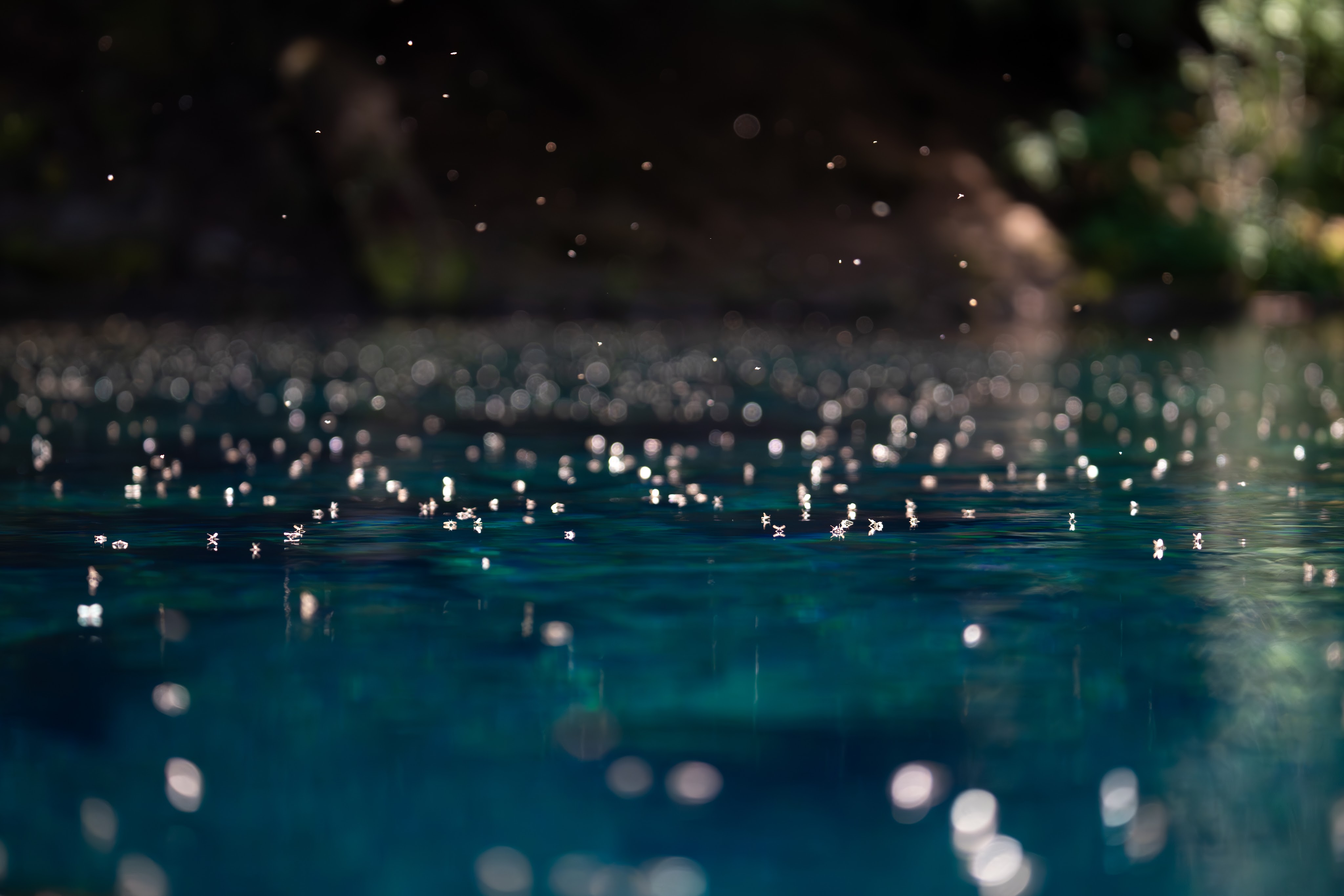
Bugs blessing the surface of the Blue Pool
Why is the ocean blue?
Water can appear to be clear, especially in small quantities. A small glass of water, for instance, allows light to pass through with seemingly no hassle. So what gives larger bodies of water a blueish hue?
While sun emits light from the ultraviolet, visible, and infrared spectrums, we’re mostly concerned with ROYGBIV here. When this band of light hits the water, absorption is highest in the ROY and IV areas, resulting in a majority of GB. Larger volumes of water provide more light absorption, pronouncing this effect, resulting in the blueness of the ocean.
While light absorption is largely responsible for the color of the ocean, it can be affected by many other factors. Pollutants, for instance, can dye water a different color. Microorganisms can also affect the color of water. Phytoplankton are capable of photosynthesizing—thanks to a green pigment known as chlorophyll—absorbing primarily red and blue wavelengths. In areas with high volumes of phytoplankton, the ocean can appear green.
What happens then, when you have a large volume of pristine, microorganism-free water?
Tamolitch Falls
The mountains of Oregon are verdantly forested, as though a flourishing canvas of evergreens was laid upon the Earth, stretching as far as the eye can see. Hidden within these endless swathes of lushness is a brilliant turquoise gem, more brilliant than any you could hold in the palm of your hand.
The Blue Pool is a basin fringed with cliffs. The water’s source is a river that was coated with a lava flow some 1,600 years ago. The porous terrain secretes water, after subjecting it to a harsh filtration process. Moreover, the water typically hovers a bone-chilling temperature of 37°F—rendering it inhospitable to microorganic life.



Cliff-Diving
If your friends jumped off a cliff, would you?
I am friends.
Using kinematic equations, we can estimate how fast I was going when I impacted the water (with helpful freedom unit conversions)!
Δx = vi t + ½(at2)
Δx = 0(1.43) + ½(-9.81 * 1.432)
Δx = -10m fallen ->32 feet
vf 2 = vi 2 + 2(aΔx)
vf 2 = 02 + 2(-9.81 * -10)
vf = 14 m/s -> 31.31 mph

While not illegal per se, jumping off of the cliffs is not recommended because of the inherent risks. You jump, fall, fall, your stomache churns and you think “Shit, this was high up”, you’re still falling, and then everything is ice cold. The water is seriously frigid—life-threateningly so. Once you’re submerged, your body’s instincts take the reigns until you crawl out of the glacial water.
All that said, it was compulsory for me to jump twice, just to feel the rush. Somehow, I was more hesitant to jump the second time around than the first—when I leapt before my countdown finished. The knowledge of the freefall that lay ahead lead to a ruminative, overthinking session. After my ultimate plunge, I realized I drew blood by chomping down on my tongue on impact.
A Neat Photo of Bugs

 David McCormick
Leave a comment