Lava Beds National Monument
Cave safely, cave softly

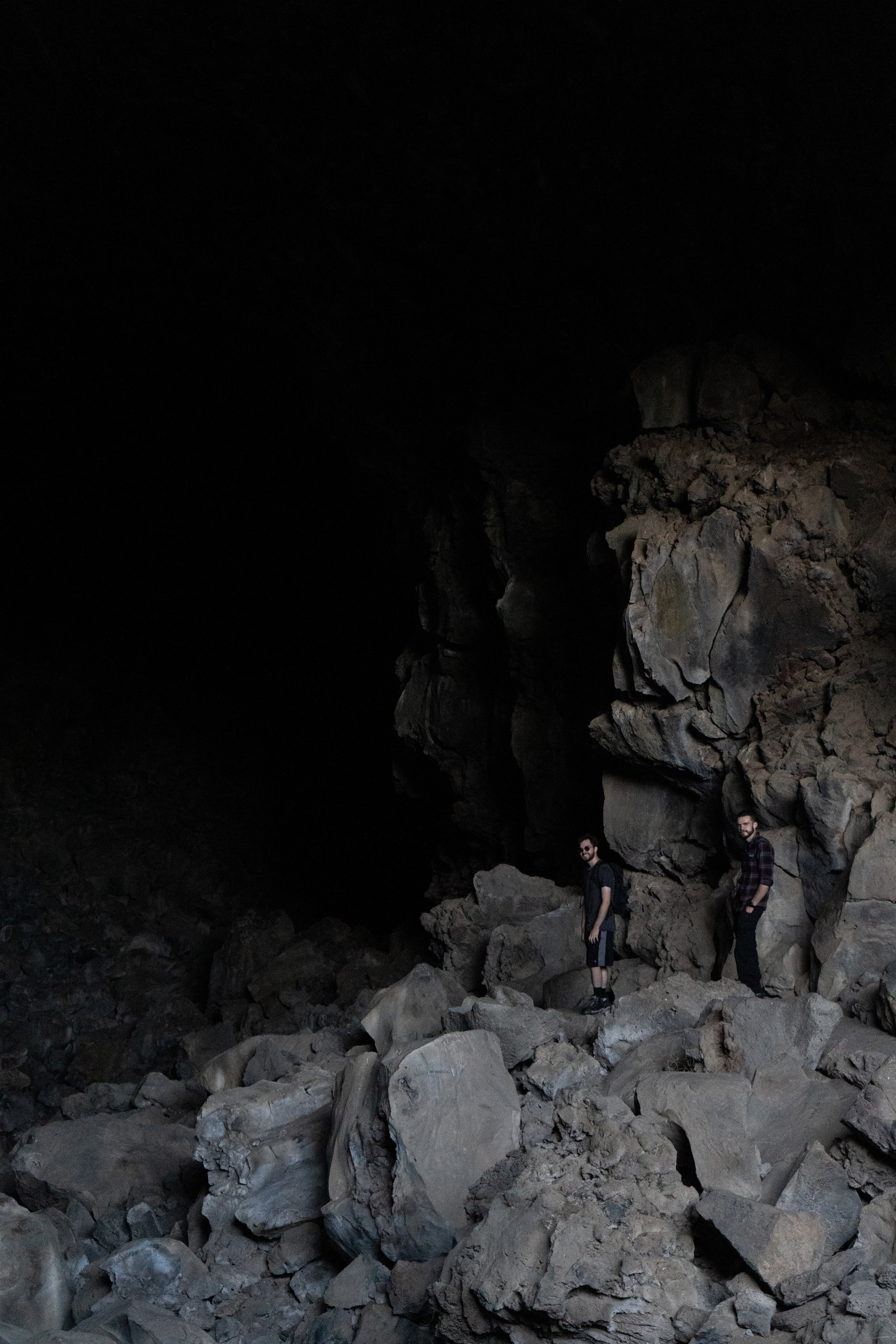
Three troglodytes exploring a dark, dank cave.
Growing up in Los Angeles, we were frequently drilled on earthquake safety. Go underneath something sturdily built with four legs; hold onto one of the legs and cover your head; hope nothing too heavy falls on you.
Once, on a Sunday well slept-in, I was rudely awoken by an earthquake. You’d think that with all the safety drilling, I would have sought cover under my bed or my desk nearby. As fear gripped my half-awake pre-frontal-cortex-lacking brain, the safest place I could think of, was under my covers. Fortunately, the roof did not collapse on top of me.
No amount of drilling can truly prepare you for the real deal. The ol’ reliable ground you walk on every day tremulates excitedly; then the house is shaking by the foundations; hanged photos propel themselves into a free-fall; you feel a sudden, gripping rush of fight-or-flight adrenaline, your stomach dropping and rattling on the floor, at which point you’ll realize: earthquake! And then, just as quick as it started, it’s over.
For billions of years, the face of the Earth has been shaped by the whims of stiff tectonic plates gliding over a ductile region called the asthenosphere. The surface pulls itself taut, or scrapes and shears against itself to form volcanos, mountains, graben. Nowhere on this planet, is this more evident, than in Iceland. A close second place, however, is California.
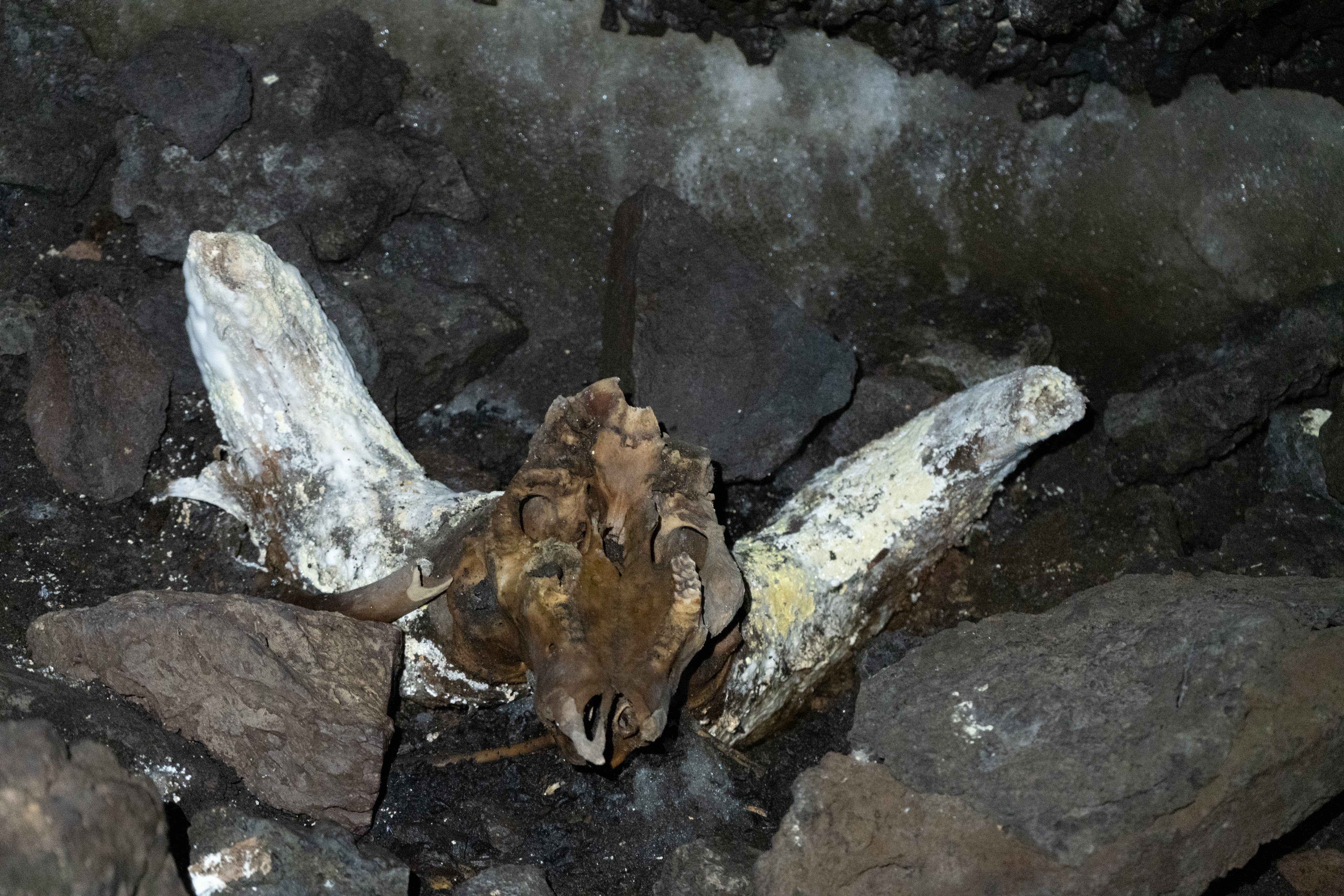
Skull Cave
If you took a geology class in 5th grade, you may recall the difference between magma and lava is that the former lay beneath the Earth’s surface and the latter flows above. Basaltic lava flows—which comprise most of the lava flows in the Lava Bed National Monument—may be divided further into two types with distinct characteristics:
- ‘A‘ā – High viscosity, leaving jagged rocks when cooled
- Pāhoehoe – Low viscosity, leaving smooth remains
Lava tubes can form when pāhoehoe cools and forms a crust, forming an insulative barrier that allows molten lava to continue flowing beneath. The molten lava will pour out downstream, hollowing out entirely and leaving the solid crust. Once all the dust has settled, it will become habitable for a diverse cast of critters.
If you took a speleology class in 5th grade, you may recall the three different zones that comprise a cave:
- Entrance Zone
- Twilight Zone (not the show)
- Dark Zone
The anatomy of a cave allows differing groups of flora and fauna to survive in the zones. The entrance zone, which is graced by the sun, is subject to variable temperatures, fosters green plants, and allows brief respite for otherwise surface-dwelling animals. The twilight zone experiences fewer temperature swings and shelters life that requires cool moisture (think bats and mushrooms). Finally, the dark zone, has a relatively constant temperature and is dark—great for creatures that have poorly developed eyes and long antennae.
In spite of our general unpreparedness and lack of antennae, my friends and I still ventured well into the dark zone of the caves of the Lava Beds National Monument. Crouching in some places, we wandered with cellphone torches. I felt an ancestral warmth, rekindling a connection with my neanderthalic forebears, as though the caves were my natural habitat. After some time, I slipped ahead of the group and crawled into some nameless recess of the cave and went dark. I waited with baited breath—truly, in the moment, a gremlin—hearing the others’ approach while they called out with uncertainty… “David?”
For all my mischief, I lightly startled Jalen and he remarked that I looked like Gollum.

Sundogs
Upon resurfacing from Skull Cave, we found the sun accompanied by a 22° halo and sundogs. In order to understand these celestial phenomenon, we must first understand the cloud formations present.
Picture a cloud.
Is it a puffy, white cloud? One that you may have drawn as a child? You are most likely thinking of a cumulus humilis cloud. Clouds, like animals, are classified using the Linnean system: genus, species, variety. The transparent, milky veil pictured below is a cirrostratus—a thin layer of ice crystals, suspended tens of thousands of feet in the air. We can be confident that the cloud is a cirrostratus because of the presence of halo phenomena.
The 22° halo stretches all around the sun. Without delving into too much detail, these form because of the way sunlight can refract off ice crystals that are shaped like hexagonal columns (unsharpened pencils). The sundogs (or parhelia) can be found level with the sun, and exist similarly due to diffraction of ice crystals, but at a different angle. For more info, see here.

 David McCormick
Leave a comment