Joshua Tree National Park
Where Two Deserts Meet

A three-legged coyote grins for a photo.
In 1994, Congress deemed Joshua Tree a national park under the California Desert Protection Act. The Joshua Tree National Park is actually comprised of two deserts: the Mojave in the West and Colorado in the East. Spanning nearly 800,000 acres (or 605,000 football fields), the fauna and flora who call these deserts home exhibit adaptations that make it possible to live in +100°F temperatures with a scarcity of water.
800,000 acres
*
43,560 sq ft
1 acre
*
1 football field
57,600 sq ft
=
605,000 football fields
The namesake of the park is scattered throughout the Mojave, hands reaching up to the sky. Similar to the palm trees of Southern California, the name “Joshua Tree” is a bit of a misnomer, as it is phylogenetically not a tree—rather, it is a species of yucca. Since the “trees” do not develop rings, scientists estimate their age by taking their height and dividing against a measured rate of approximately one inch per year. Its waxy, needlelike leaves leave little room for moisture to escape. Additionally, dead or alive, the Joshua Trees provide countless species of animals with habitation.
Barker Dam
Equipped with the Tamron 150-500mm F/5-6.7 lens and traveling with three friends, Joshua Tree was to be the first destination of a multi-day, multi-state road-trip. We hit the road early from Los Angeles and arrived at the northwest entrance of the park making good time. Sitting in the backseat, I was free to fiddle around with my new lens while we baked in the late morning heat, waiting behind other eager visitees paying the entrance fee. The moment I put my lens back into my bag, a greater roadrunner with Desert Lizard au jus scurried into the distance.
After missing my first photo op, we drove to our first stop: Barker Dam. Luis graciously provided us with the stickiest sunscreen that has ever graced this Earth, which Jalen promptly sprayed into his bare eyes (he would not stop whinging about it for the WHOLE DAY). Seeing as though it hadn’t rained in a while, the Dam was moreso a pool of what appeared to be irradiated marsh water. We chanced upon a Tarantula Hawk, whose diet consists mainly of tarantulas. The Starr sting pain scale, created by entomologist/masochist Christopher Starr, places a tarantula hawk’s string at a four (the highest on the scale—for reference apis mellifera ranks at a two).


Further along the trail, I was able to glimpse a leopard lizard. It has long toes with claws on its posterior legs and a decal specialized for blending in with its surroundings. This shot focused on the toes rather than the head (totally on purpose).
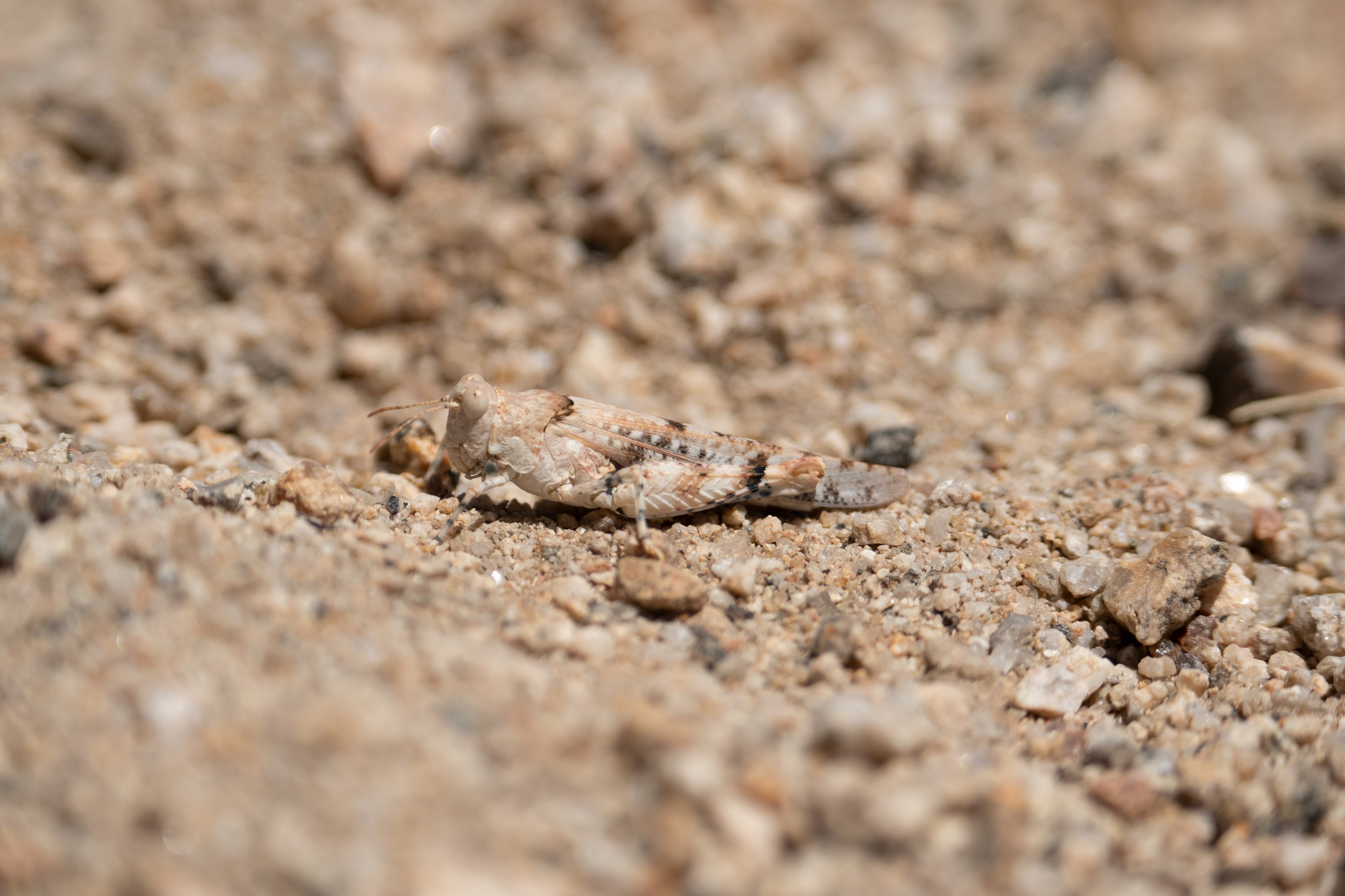
Some movement caught my eye while marching back to the car. Given a closer look, I was able to capture this photo of a bug. For some reason, I shot this at 200mm, but it still looks quite sharp when cropped.
Skull Rock
Following our Barker Dam excursion, we headed eastward to Skull Rock. The monumental rock formations in the park began as magma (molten rock underneath the surface—not to be confused with lava, which breaches the surface) which gradually cooled. This cooling and eventual contact with groundwater formed cracks and smoothed the geologic surfaces. Eventually, the surface soil weathered away and unveiled these magnificent geologic creations.

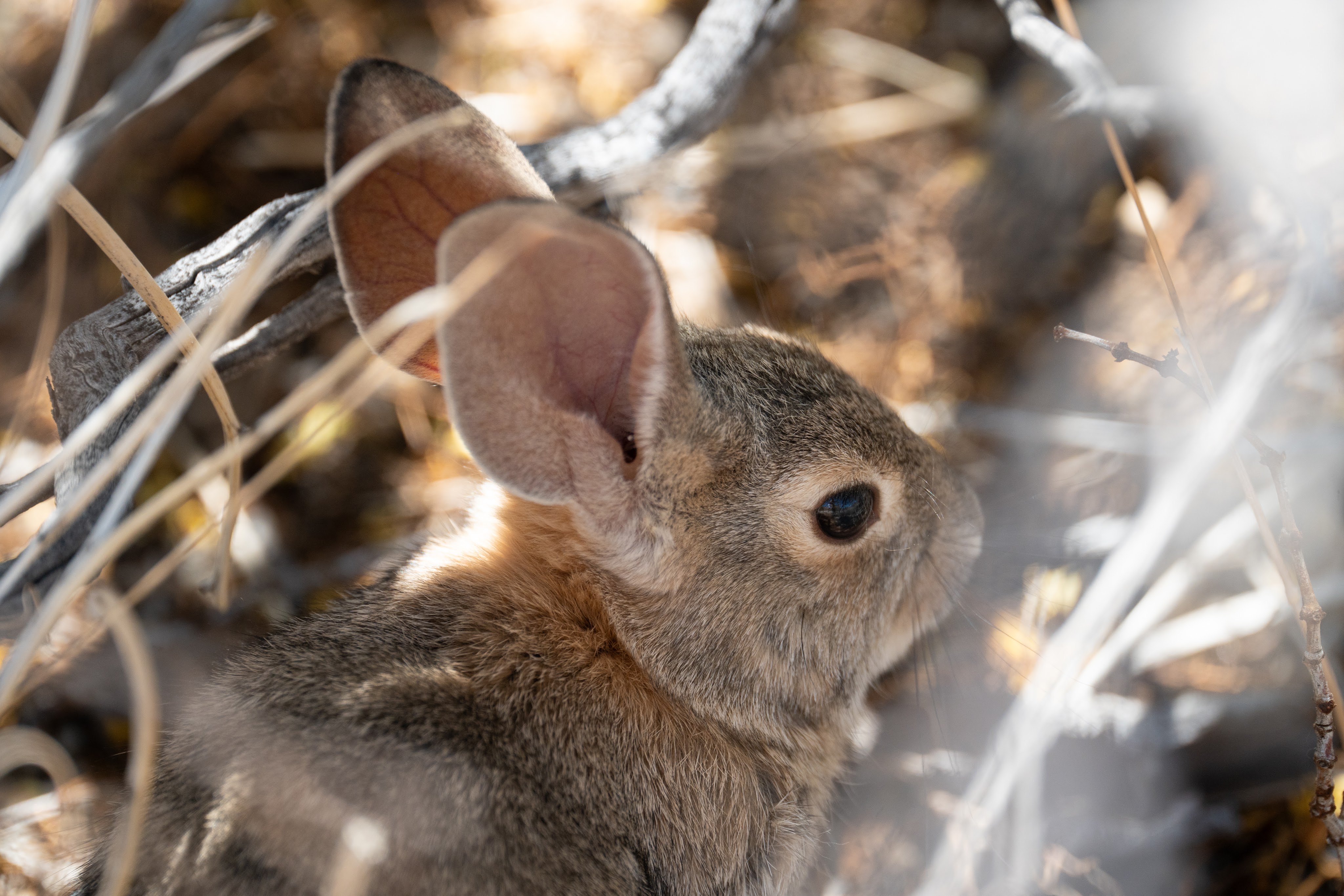


In addition to the wonderous outcroppings, I spotted a bunny seeking shelter from the sun in a nearby bush. The bunny is able to circulate blood to the veins lining the ears, which can help vent excess heat. If you zoom in on the eye of the bunny, you can almost make out the silhouette of me taking the photograph.
The lizard featured in the gallery is a western chuckwalla. They can often be seen, basking in the sun in order to absorb heat from the sun to digest consumed plants. They are quite skittish, so any photograph had to be taken from a distance. Fortunately, I was able to shoot in 500mm with ease due to my camera sensor also basking in the sun.
Cholla Cactus Garden
Our final destination in Joshua Tree National Park was the Cholla Cactus Garden, located on the Pinto Basin Road which conveniently deltas southwest of where we had began. Before we could visit the Cactus Garden, we had to take a detour to civilization because SOMEONE forgot to bring water to THE DESERT (@jalen.landis). On our way out of the park, a coyote stopped in the middle of the road and I began screaming to pull over so I could hop out of the car. The kind fellow posed for some photos and we went our separate ways.
Upon reaching the destination, we were assaulted by a deluge of bees. With flowering cacti in abundance, the garden is a veritable oasis for the bees. Cactus wren, compatriots of the bees, were also present, proudly perched atop the cacti despite the cacti’s spikiness. The cactus wren are wholly unphased by the cacti’s natural defense mechanisms, hastily departing and landing upon the cacti without pause. Photographers, on the other hand, are not immune to thorns, and thus vulnerable while engaging in a wild wren chase.

 David McCormick
Leave a comment